Comparing Options for Accessing Life Insurance Funds

Living benefits and life settlements can both provide access to the value of a life insurance policy before death, but they are fundamentally different transactions.
Life insurance is generally designed to provide a death benefit to beneficiaries when the insured dies.
But some policies can provide access to policy value while the insured is still living.
Two options that are often discussed are living benefits, including accelerated death benefits, and life settlements.
They can sound similar because both can provide money before death. The mechanics are not similar.
An accelerated death benefit generally involves the insurance company advancing some portion of the policy's death benefit when the insured meets the conditions specified in the policy.
A life settlement is different. It involves the policyowner selling the life insurance policy to a third party for a negotiated amount. The buyer becomes the new owner and/or beneficiary of the policy and generally assumes responsibility for future premiums.
Those differences affect the policy, the death benefit, the ownership of the contract, potential taxes and the people who ultimately receive the death benefit.
Understanding those differences is important before comparing the two.
What is a living benefit?
The National Association of Insurance Commissioners, or NAIC, describes an accelerated death benefit as a type of living benefit. It allows a policyowner to access part of the death benefit before death when the insured meets specified conditions, such as having a qualifying terminal illness.
The exact conditions are determined by the policy.
Depending on the contract, qualifying circumstances can include terminal illness or chronic illness. The IRS also defines an accelerated death benefit as an amount paid under a life insurance contract for an insured individual who is terminally or chronically ill.
The important point is that a living benefit is generally a feature of the existing insurance policy.
The policy is not being sold to an outside buyer.
Instead, the insurer provides an accelerated payment under the terms of the contract.
What happens to the death benefit?
An accelerated death benefit generally involves accessing part of the death benefit before the insured's death.
The amount available, the qualifying conditions and the way the remaining death benefit is calculated depend on the policy and rider.
The payment can therefore affect the amount ultimately available to beneficiaries.
Policyowners should review the actual policy provisions before assuming that receiving an accelerated benefit simply means receiving part of the death benefit with no other consequences.
The NAIC advises consumers to understand how their policy's accelerated benefit works before using it.
What is a life settlement?
A life settlement is a different type of transaction.
The policyowner sells an existing life insurance policy to a third party for an amount greater than the policy's cash surrender value but less than the policy's death benefit. The buyer becomes the new owner and/or beneficiary of the policy.
The buyer then has an economic interest in the policy remaining in force and generally takes responsibility for future premiums.
The original policyowner receives the settlement proceeds and gives up ownership of the policy.
That means the original policyowner no longer controls the policy in the same way they did before the sale.
The future death benefit belongs to the new owner, subject to the terms of the transaction and policy.
The biggest difference is the transaction itself
The easiest way to distinguish the two is to look at what happens to the policy.
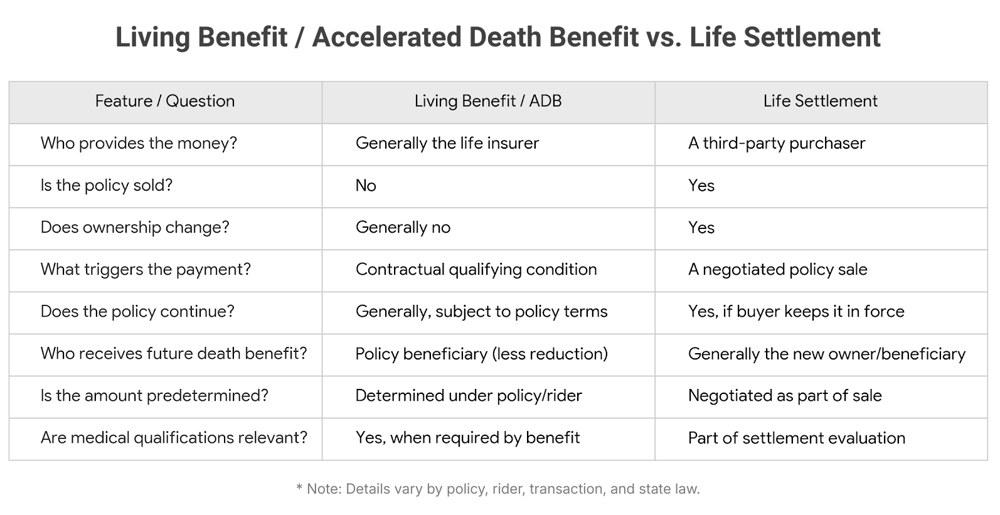
The details can vary by policy, rider, transaction and state law, so these categories should not be treated as identical across every situation.
A life settlement is not the same as surrendering a policy
This distinction matters.
When a policyowner surrenders a life insurance policy, the policy is terminated and the owner receives the policy's cash surrender value, if one exists.
The IRS states that when a policy is surrendered for cash, the amount received above the policyowner's cost in the contract is generally included in income. The calculation can be affected by items such as unrepaid policy loans and other adjustments.
A life settlement is a sale of the policy to another party.
The amount paid in a life settlement is therefore determined differently from the cash surrender value.
The IRS has specific rules governing the federal tax treatment of a sale of a life insurance contract. Under current rules, the seller's taxable gain is determined using the amount realized from the sale and the policy's adjusted basis.
That makes the distinction between surrender value and settlement proceeds important.
They are different transactions.
Medical qualification is another important difference
Living benefits are tied to the specific qualifying conditions in the policy or rider.
For example, the NAIC identifies accelerated death benefits as benefits that may become available when an insured has a qualifying terminal illness. The IRS recognizes accelerated death benefits involving terminally or chronically ill individuals for purposes of the federal tax rules described in its publications.
A life settlement is not limited to the same contractual trigger.
A life settlement evaluates the policy and the insured's circumstances as part of determining whether a third-party purchaser is willing to buy the policy and at what price.
Eligibility requirements vary by transaction, policy and state.
This is one reason the terms life settlement and viatical settlement should not be used interchangeably without looking at the facts.
Viatical settlements generally involve insured individuals who are terminally or chronically ill and have specific statutory and tax treatment. The IRS specifically distinguishes certain viatical transactions involving terminally or chronically ill individuals from other life insurance transactions.
Taxes need to be considered separately
Neither option should be described as automatically tax-free.
Federal tax treatment depends on the type of transaction and the circumstances.
The IRS states that certain accelerated death benefits received by terminally or chronically ill individuals can qualify for exclusion from income when the applicable requirements are met.
The tax treatment of a life insurance policy sale is different.
IRS Revenue Ruling 2020-05 explains that, under the current basis rules, the gain on a life insurance contract sale is generally determined by comparing the amount realized with the policy's adjusted basis. The ruling also addresses how the proceeds can contain different character components for federal tax purposes.
A policyowner considering either option should therefore have the transaction reviewed by an appropriate tax professional before proceeding.
What happens to the beneficiaries?
This is one of the most significant differences between the two approaches.
With an accelerated death benefit, the policy remains in place, subject to the policy's terms. The amount available to beneficiaries can be affected by the benefit payment.
With a life settlement, the policyowner sells the contract.
The purchaser acquires the policy rights associated with the transaction, and the original beneficiaries generally no longer receive the policy's death benefit because the ownership and beneficiary interests have changed.
The NAIC advises consumers considering a life settlement to understand the transaction, compare offers and consider the consequences before accepting an offer.
There can also be effects beyond the life insurance policy
A life settlement can affect more than the policy itself.
FINRA has noted that life settlements can involve transaction costs and potential consequences involving taxes, future insurability and eligibility for certain government benefits.
The NAIC also encourages consumers to understand the process, review application information carefully, understand the use of escrow arrangements and determine whether a state provides a period during which a completed transaction can be rescinded.
These issues do not mean a life settlement is appropriate or inappropriate.
They mean the transaction needs to be evaluated as a financial and insurance decision rather than simply as a way to obtain cash.
The two options answer different questions
Living benefits and life settlements can both provide access to life insurance value during the insured's lifetime.
But they address different circumstances.
A living benefit asks:
Does this policy provide a benefit that allows the insured to access part of the death benefit because a qualifying event has occurred?
A life settlement asks:
What is the policy worth in a third-party transaction, and does selling the policy make sense given the owner's current circumstances and the value being given up?
Those are very different questions.
One uses a feature within the existing insurance contract.
The other transfers ownership of the contract.
What should a policyowner compare?
Before making a decision, the relevant information can include:
- Current death benefit
- Cash surrender value
- Policy basis
- Outstanding policy loans
- Current premium requirements
- Future premium projections
- Policy type
- Available living benefit provisions
- Qualifying conditions for any accelerated benefit
- Amount available under the living benefit
- Effect on the remaining death benefit
- Potential life settlement value
- Tax consequences
- Effect on beneficiaries
- Effect on future insurance needs
- Possible impact on government benefits
- State-specific consumer protections
- Any applicable rescission period
The actual policy documents and transaction documents should be reviewed rather than relying on a general description of either option.
There is more than one way to access policy value
A life insurance policy can represent a significant financial asset, but the way that value is accessed matters.
An accelerated death benefit is a contractual feature that may provide access to part of the death benefit when specified conditions are met.
A life settlement is a sale of the policy to a third party.
Neither description tells a policyowner which option is appropriate.
That requires looking at the policy, the owner's objectives, the financial consequences, the tax treatment and the effect on the people who would otherwise receive the death benefit.
The first step is understanding that these are two different transactions, not two names for the same thing.
Editorial Disclosure
This article is provided for general educational purposes only and is not insurance, financial, legal or tax advice. Living benefit provisions, life settlement eligibility, transaction requirements, tax treatment and consumer protections can vary by policy, state and individual circumstances. Policyowners should review their policy documents and consult appropriately licensed insurance, financial, legal and tax professionals before making decisions involving a life insurance policy.
Sources & Editorial References
National Association of Insurance Commissioners (NAIC)
Life Insurance Consumer Information and Understanding Life Settlements: Selling Your Life Insurance Policy. The NAIC identifies accelerated death benefits as living benefits and provides consumer information regarding life settlements, including the mechanics of selling a policy and consumer considerations.
Internal Revenue Service (IRS)
Publication 907, Tax Highlights for Persons With Disabilities and Publication 525, Taxable and Nontaxable Income. These sources address federal tax treatment of accelerated death benefits and certain viatical settlement proceeds.
Internal Revenue Service (IRS)
Revenue Ruling 2020-05. Provides current federal income-tax guidance concerning the basis and gain or loss associated with the sale of life insurance contracts.
Internal Revenue Service (IRS)
Revenue Ruling 2009-13. Provides federal tax guidance concerning sales and surrenders of life insurance contracts. Its basis rules were subsequently modified by the Tax Cuts and Jobs Act, as addressed in Revenue Ruling 2020-05.
FINRA
Consumer and investor information concerning life settlements and considerations including transaction costs, taxes, insurability and potential government-benefit consequences.